L’Oseraie de l’île — Baskets Born from the Willow Fields | Germany Business Trip Journal 10 / L’Oseraie de l’île やなぎ畑から生まれるかご ―ドイツ出張記 10

In southwestern France, near Bordeaux,
Karen and Corentin weave baskets at a farm surrounded by willow fields called “L’Oseraie de l’île.”
Of course, the two of them did not begin their journey together.
They were each born and raised in different regions of France,
and through their own backgrounds, each found their way to basket making.

An Encounter with Willow
Karen studied at an art school, but the program focused heavily on conceptual lectures,
which she says left her feeling a strong sense of frustration.
During a study trip to Ireland organized by the school,
she encountered willow basket weaving for the first time—and she says that the willow immediately spoke to her.

The scent of the willow, the techniques.
Just a few simple tools, a handful of branches,
and the act of creating form with nothing more than one’s own hands.
She says it all felt like magic.

Corentin, on the other hand, began basket making for a different reason.
At the time, his mother was ill, and he says he simply wanted to find something they could share together.

It was in the midst of those circumstances that he encountered the traditional basket known as “Bouyricou,” along with the maker who wove it. He says the experience was something like love at first sight. 
He was immediately captivated by the beauty of its spiral form, and felt a strong desire to learn more deeply. It reminded him of the feeling he had as a child, carving wood with a knife in his pocket.
He says that sense returned to him again through this craft.

Their Meeting and the Beginning of L’Oseraie de l’île
The two of them met at a craft market held in France.
They were immediately drawn to each other’s skills and soon felt a desire to share their craft together.
And as they say, “love tied it all together.”
Although they each come from different regions of France,
one day Corentin learned that the farm in southwestern France where he had been sourcing willow
—“L’Oseraie de l’île”—was up for sale.
It was a farm that had been run primarily for the cultivation of willow.

“For two basket makers, it felt like the beginning of a wonderful adventure.”
And so the two of them took over seven hectares of willow fields,
and began cultivating willow mainly used for tying vines in the vineyards of the Bordeaux region.
Later, they reduced the scale of cultivation,
and now grow only the amount needed for their own basket making.

The Meaning of Growing Willow
A similar situation can be seen in Japanese bamboo craft,
but in France and across Europe as well, the number of places supplying good willow materials is gradually decreasing.
Managing and cultivating willow themselves must be truly demanding work.
Even so, they say that it carries great meaning, and that it is a very beautiful way of working.
“Being able to grow the material ourselves, in the way we believe in, while respecting nature,
feels both sensible and deeply satisfying,” they say.

Today, the two of them cultivate around twenty different varieties of willow.
“By growing the willow ourselves, we can choose varieties that suit the land,
and we are also able to experiment with many different types.”
However, the length and condition of the willow that grows each year
is ultimately shaped by nature, and does not always turn out exactly as expected.
They say that this means the maker must remain flexible,
adapting their work to the character of the willow grown under that year’s natural conditions.

The two of them say:
“We would like our customers to understand that the color of willow comes from nature,
and that the resources available each year are limited.”
“Sometimes we decide the shape of the baskets according to the condition and quantity of the willow harvested that year.
We do not select the material to fit the basket.
Rather, we shape the baskets according to the material.
In many ways, this way of thinking reflects the logic of farmers.”

When I heard these words, it made me pause.
While the two of them create traditional and practical French baskets such as the Bouyricou,
they also produce “art” and “objects” that make use of traditional techniques.
Because of that image, I had unconsciously assumed that
what they wished to create—the forms and ideas they had in mind—came before the condition of the materials.

Yet behind the art and object works of theirs that I see,
I realized that there is another side: the life they have rooted in the land called “L’Oseraie de l’île.”
There, they face the willow and the fields each day,
working within a grounded way of life that is closely connected to the land.

Rather, their work is art born from the gift of willow that nature provides.
Reading these words gave me a quiet sense of reassurance and joy.
More than anything, it deepened my trust in the two of them.

About Their Basket Making
“What attracts us is the ‘technical challenge’ that the material of willow presents to us through its form.
And we enjoy creating movement within the weaving,
making use of the curves of willow and the natural tension of the material itself.”

“That inspiration can be found everywhere—
in the beauty and simplicity of curves, and in many other places as well.”

At times, they also collaborate on larger works together.
The exchanges that take place as a “duo,” facing each other through the process of making,
have also become an important source of energy for their creativity.


When weaving a basket, they say it is important to look closely at the character of each individual willow rod,
drawing out the qualities of the material and making the most of them.
“The play of balance in tension.”
Each willow rod has its own tension and flexibility.
By weaving while sensing the balance of that force—neither pulling too tightly nor leaving it too loose—
a natural movement begins to emerge within the work.

And just as in sculpture,
they say it is important to stop at the right moment—when a beautiful curve has emerged.

“The time we spend together in the workshop,
weaving willow at our own rhythm—
that is our joy,
and it is also our way of life.”

Since first meeting them in 2015, many years have passed,
and we are finally able to introduce their baskets here at our shop.
I am truly happy that the day has come when we can share their work with you.

The first baskets the two of them have sent to Japan are the traditional “Bouyricou” baskets, which begin with the spiral base weave that once changed Corentin’s path. They come in two sizes. 
There is also a basket bag by Karen, whose softly rounded curves immediately catch the eye. 
And the spirals that flow one after another—a form I have long admired. 
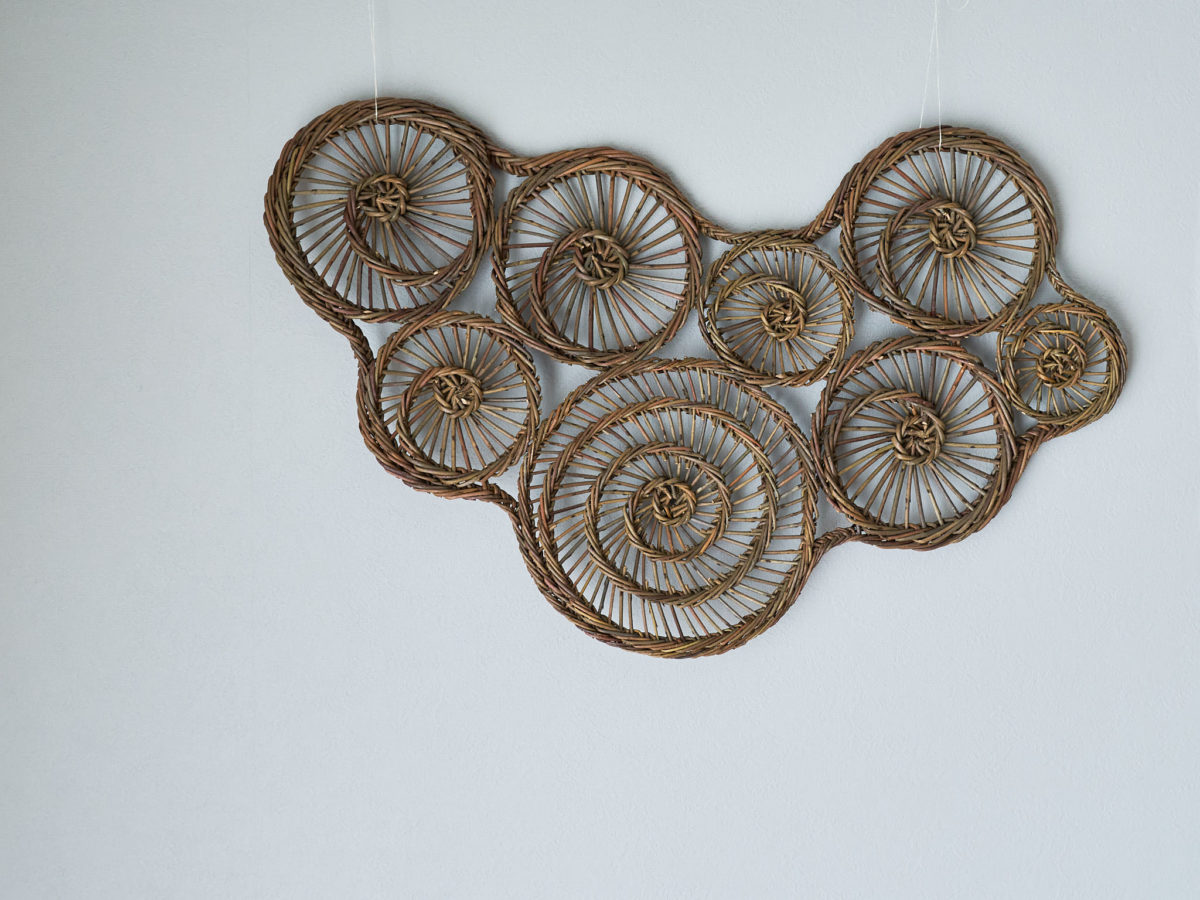
They also sent a wall decoration titled “Petit Engrenages,”
specially created for our shop.
You can see them in person at our shop in Minami-Senju, Tokyo.
We invite you to take this opportunity to discover the baskets of Karen and Corentin of “L’Oseraie de l’île,”
formed from the gifts of willow.
At the basket festival in Lichtenfels, Germany,
a short film festival has also been held alongside the event in recent years.
In 2025, a film capturing the couple’s process of making baskets received the Grand Prix.
Film by Héloïse Allemandou
https://www.heloiseallemandou.com/
The film beautifully captures scenes of willow harvesting and basket making in their workshop,
with an atmosphere reminiscent of a French film.
Please take a moment and enjoy it.
To be continued.
Photos courtesy of L’Oseraie de l’île
Product photography by 1basketry